

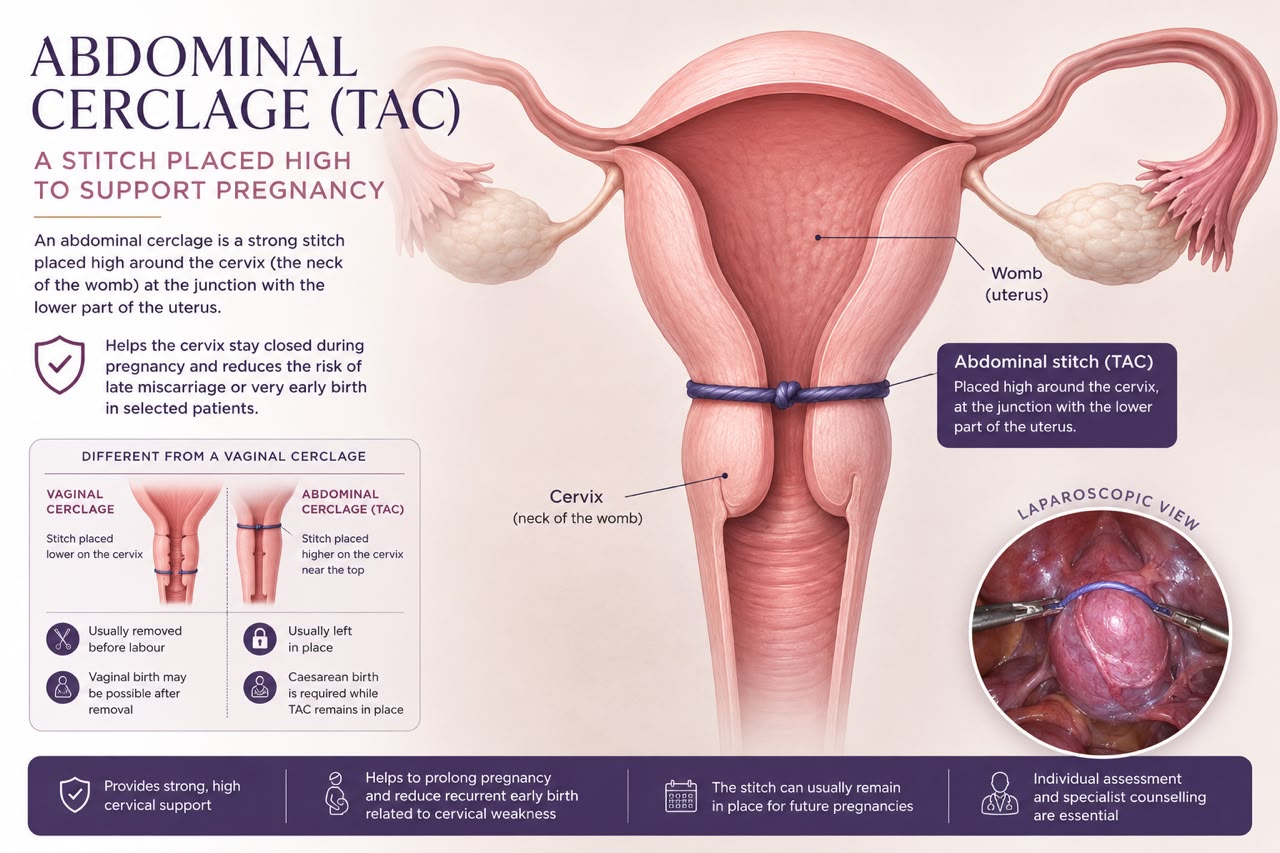
For women who have experienced recurrent second-trimester pregnancy loss or an extremely premature birth associated with cervical insufficiency, planning another pregnancy can bring both hope and understandable anxiety. In carefully selected patients, a transabdominal cerclage may provide stronger support to the cervix when a conventional vaginal cervical stitch is unsuitable or has not previously been successful.
I recently performed a laparoscopic transabdominal cerclage in Durban. Selected educational footage from the operation is included in the accompanying video. The procedure demonstrates how advanced minimal-access surgery can be applied to a complex obstetric condition while using small abdominal incisions and precise laparoscopic visualisation.
As a Specialist Obstetrician and Gynaecologist, with additional diploma in laparoscopic surgery (D.MAS), practising at Netcare Parklands Hospital in Overport, Durban, my approach begins with a detailed assessment of each patient’s pregnancy history, previous procedures, cervical anatomy and future pregnancy plans. An abdominal cerclage is an important operation and is not appropriate for every patient with a shortened or weakened cervix.
A transabdominal cerclage, often abbreviated to TAC, is a strong suture placed around the upper part of the cervix, close to the junction between the cervix and the lower uterus. Its purpose is to provide mechanical support and help the cervix remain closed as a pregnancy progresses.
Unlike the more commonly performed transvaginal cerclage, an abdominal cerclage is inserted through the abdomen and can be positioned higher around the cervix. This higher placement may be beneficial when there is insufficient cervical tissue for a vaginal stitch, the anatomy makes vaginal placement difficult, or a correctly placed vaginal cerclage has previously failed.
A transabdominal cerclage may be placed through traditional open abdominal surgery or by laparoscopy. International specialist guidance recognises both approaches, with the choice depending on factors such as pregnancy status, surgical feasibility, available resources and the treating team’s expertise.
The cervix is the lower part of the uterus and normally remains closed during pregnancy until the body is ready for childbirth. Cervical insufficiency describes a situation in which the cervix begins to shorten, open or dilate too early, sometimes with few obvious symptoms or painful contractions.
This may contribute to pregnancy loss during the second trimester or very early premature birth. However, not every late miscarriage or premature delivery is caused by cervical insufficiency. A careful review is needed to consider other possible causes, including infection, uterine abnormalities, placental complications and spontaneous preterm labour.
During the recent procedure shown in the accompanying video, a laparoscopic approach was used. A camera and specialised instruments were introduced through small abdominal incisions, allowing the pelvic structures to be viewed under magnification.
The suture was carefully positioned high around the cervix at the cervico-isthmic region. This is a technically demanding area situated near important blood vessels and surrounding organs. Clear identification of the relevant anatomy and precise placement of the cerclage are therefore essential.
The purpose of sharing selected footage is educational. It gives patients a clearer understanding of how a laparoscopic abdominal cerclage is performed without displaying unnecessary or identifying clinical information.
No operation or cervical stitch can guarantee that a pregnancy will reach full term. The aim of TAC is to reduce the risk associated with cervical insufficiency in appropriately selected patients and form part of an individualised pregnancy-care plan.
A transabdominal cerclage can be placed before pregnancy or during an early stage of pregnancy. Pre-pregnancy placement has practical advantages because the uterus is smaller and there is no pregnancy to consider during surgery.
International guidance indicates that placement before pregnancy and placement during the first trimester can have similar fetal outcomes in appropriately selected cases. In certain circumstances, TAC may still be considered later, but the timing and risks require careful specialist evaluation.
The correct timing is determined individually after considering the patient’s medical history, whether she is currently pregnant, previous pregnancy outcomes and any other health concerns.
Although laparoscopic abdominal cerclage is performed to improve future pregnancy support, it is still a significant surgical procedure. Possible risks include bleeding, infection, anaesthetic complications, blood clots and injury to nearby structures such as the bladder, bowel, uterus or blood vessels. There is also a possibility that open surgery may become necessary.
When the procedure is performed during pregnancy, additional pregnancy-related risks must be discussed. The nature and likelihood of complications vary according to the timing of surgery and each patient’s individual circumstances.
Patients should also understand that an abdominal cerclage is not generally removed through the vagina. Because the stitch remains high around the cervix, delivery normally needs to take place by caesarean section. Current specialist guidance suggests planning caesarean delivery between 37 and 39 weeks when a TAC remains in place, although the final timing depends on the mother’s and baby’s clinical circumstances.
In many cases, the cerclage can remain in place for a future pregnancy. This should be discussed with the treating obstetrician, particularly when considering family planning or further pregnancy.
A transabdominal cerclage is one part of an ongoing pregnancy-management plan. Patients still require routine antenatal care and any additional monitoring recommended for their individual risk profile.
Current specialist guidance does not recommend routine transvaginal cervical-length screening once a transabdominal cerclage is in place. Some patients who remain at risk of recurrent spontaneous premature birth may be offered a discussion about additional treatment, including vaginal progesterone. Such decisions require shared decision-making after the possible benefits, limitations and risks have been explained.
The aim is to provide coordinated, evidence-informed care throughout the pregnancy rather than viewing the operation as a stand-alone solution.
A laparoscopic transabdominal cerclage is not normally the first treatment offered to every patient at risk of premature birth. It may be considered in circumstances such as:
– A previous vaginal cerclage followed by another very early spontaneous delivery or pregnancy loss
– A cervix that is too short, scarred or anatomically unsuitable for vaginal cerclage
– Previous cervical surgery that makes vaginal stitch placement difficult
– Significant cervical trauma or removal of cervical tissue
– A specialist assessment indicating that higher cerclage placement may provide more appropriate support
TAC should be offered for consideration to patients who previously had a history-indicated or ultrasound-indicated vaginal cerclage and subsequently experienced a spontaneous singleton delivery before 28 weeks.
This guideline does not replace personalised care. The decision should follow detailed counselling, ideally involving high-risk pregnancy or maternal-fetal medicine expertise where appropriate.
Where technically appropriate, laparoscopic surgery may offer several advantages compared with an open abdominal operation:
– Smaller abdominal incisions
– Less postoperative discomfort for many patients
– Reduced abdominal scarring
– A shorter hospital stay in suitable cases
– Faster return to normal daily activities
– Magnified views that support precise surgical dissection and stitch placement
These are potential benefits rather than guarantees. The safest approach depends on the patient’s anatomy, pregnancy status, previous surgery and overall clinical circumstances. Occasionally, it may be necessary to change from laparoscopic to open surgery to complete an operation safely.
My Fellowship and Diploma in Minimal Access Surgery through the World Laparoscopy Hospital in India further strengthened my training in laparoscopic techniques, surgical anatomy, intracorporeal suturing and the safe performance of minimal-access procedures.
Is abdominal cerclage the same as a vaginal cervical stitch?
No. A vaginal cerclage is placed through the vagina, while an abdominal cerclage is positioned higher around the cervix through the abdomen. Vaginal cerclage remains appropriate for many patients. TAC is generally reserved for specific high-risk circumstances.
Can I have an abdominal cerclage before becoming pregnant?
Yes. TAC can be placed before conception and is frequently planned during pre-pregnancy care. The best timing should be decided after a specialist consultation.
Will I need a caesarean section?
Yes, delivery generally needs to be by caesarean section while a transabdominal cerclage remains in place because the stitch prevents the cervix from opening normally for vaginal birth.
Can the cerclage remain in place for another pregnancy?
In many cases, it can remain in place for future pregnancies. This depends on the patient’s circumstances and reproductive plans and should be discussed during follow-up.
Does abdominal cerclage guarantee a full-term pregnancy?
No procedure can guarantee a particular pregnancy outcome. TAC is intended to reduce the risk associated with cervical insufficiency in appropriately selected patients, but other pregnancy complications may still occur.
Recovery differs from one patient to another. Patients may experience mild abdominal discomfort, tiredness, bloating or tenderness around the small incision sites. Pain relief and postoperative instructions are provided according to individual needs.
Patients should follow the advice given about wound care, physical activity, sexual intercourse, medication, driving and returning to work. Follow-up is important so that healing can be assessed and the plan for a current or future pregnancy can be reviewed.
Urgent medical attention should be sought for heavy bleeding, severe or increasing abdominal pain, fever, shortness of breath, persistent vomiting, fluid leaking from the vagina during pregnancy, regular painful contractions or any other concerning symptoms.
Ovarian cysts are common and often require careful monitoring. I provide thorough evaluations and
treatment options for ovarian cysts, ranging from hormonal treatments to minimally invasive surgeries,
when necessary. Women in Durban and surrounding areas like Overport and Berea can rely on my
experience to guide them through the best options for their health.
No procedure can guarantee a particular pregnancy outcome. TAC is intended to reduce the risk associated with cervical insufficiency in appropriately selected patients, but other pregnancy complications may still occur.
If you have experienced a second-trimester pregnancy loss, a very early premature birth, an unsuccessful vaginal cerclage or previous surgery affecting your cervix, a specialist assessment can help determine which options may be appropriate for you.
Dr B. Nodada provides specialist obstetric, gynaecological and laparoscopic care at Netcare Parklands Hospital in Overport, Durban, serving patients from Berea, Musgrave, Morningside, Glenwood, Durban North, Umhlanga, Westville and surrounding communities.
Contact Dr B. Nodada’s practice to arrange a pre-pregnancy or gynaecological consultation. Please add the practice’s verified telephone number and online booking link here before publishing.